

where technique meets imagination
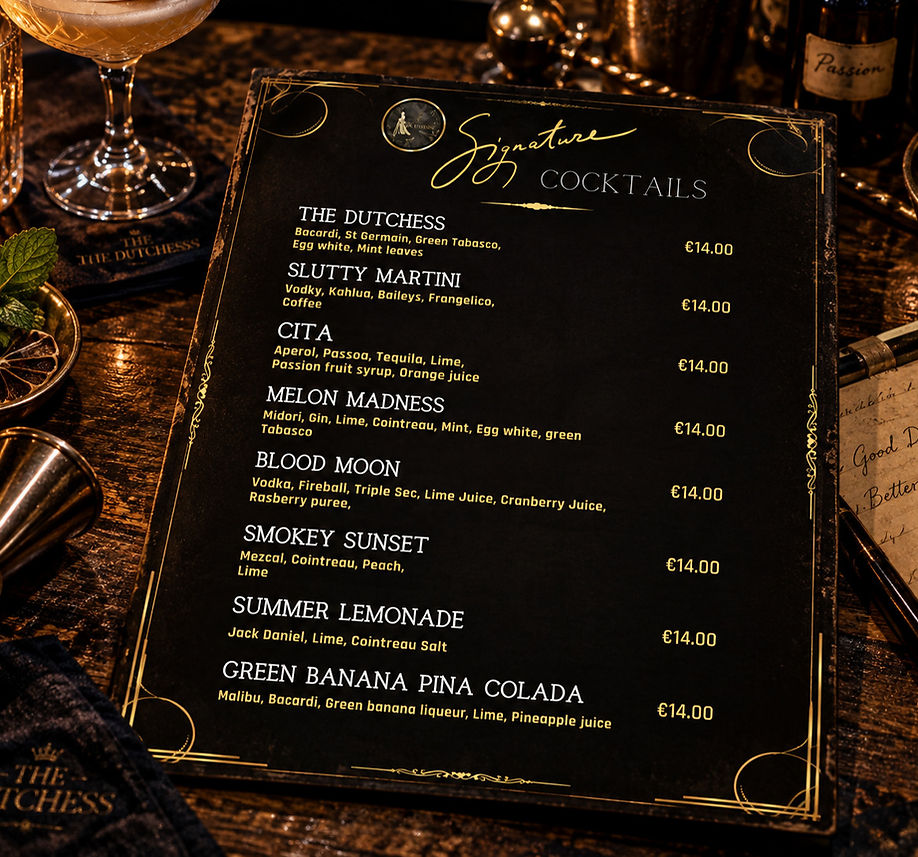
A signature cocktail does not begin with a recipe.
It begins with someone who knows what they are doing.
Our mixologists bring years of experience, a sharp understanding of flavour and a healthy curiosity behind the bar. They work with ingredients, techniques and combinations until something emerges that feels distinctly their own.
Some ideas never make it past the mixing glass. Others keep coming back until they earn their place on the menu.
These are The Dutchess Signature Cocktails, created behind this door, by the people who know the craft.
SOME THINGS NEVER GO OUT OF STYLE.
Not every drink needs to reinvent itself.
Some have been poured, stirred, shaken and argued over for generations and somehow they keep finding their way back onto the bar.
The classics are here for a reason. A good Martini does not need an introduction, and a Negroni rarely needs convincing.
So we keep a few favourites close at hand, alongside the drinks we simply enjoy making and drinking.
The classics, the familiar ones & the ones you already know you want.

THE ART OF THE COCKTAIL
where flavor meets the night
A cocktail is more than what's in the glass.
It's a fleeting moment of pure sensation.

THE STORY BEHIND THE GLASS
before the cocktail
became a cocktail
Long before the word cocktail appeared in print, people were already mixing spirits with sugar, water, herbs, spices and bitters. Some combinations were practical, some medicinal, some simply designed to make strong alcohol a little more enjoyable.
What began as improvisation slowly became intention. Recipes were refined, techniques were developed, bartenders began to build reputations around what they created, and certain drinks started to travel far beyond the bars in which they were first poured.
Over time, the cocktail became more than a mixture in a glass. It became part of nightlife, hospitality, fashion and culture; shaped by changing tastes, new ingredients, famous bartenders, political upheaval and the cities that made drinking an art form of its own.
But before all of that, there was simply the idea of combining things and discovering that the result could become something entirely new.
So let’s go back to the beginning.

MIXED BEFORE IT WAS NAMED
BEFORE THERE WAS A COCKTAIL
Long before the cocktail had a name, people were already combining spirits with sugar, water, herbs, spices and bitters.
These early mixtures were not created according to strict recipes. They were practical, improvised and often influenced by medicine, trade and whatever ingredients were available. Strong spirits could be softened with sugar, sharpened with bitters or changed completely with citrus, herbs and water.
There was no shaker, no carefully measured pour and no idea yet of the bartender as we know it today. What mattered was the simple act of mixing, testing what worked, adjusting taste and discovering that several ordinary ingredients could create something far more interesting together.
Those experiments laid the foundation for everything that followed.
Before the cocktail became a recipe, a ritual or a culture, it was simply an idea taking shape in the glass.

THE MIX GETS A NAME
WHEN A DRINK BECAME A WORD
By the beginning of the 19th century, the mixture itself was no longer the only thing taking shape. A name began to appear.
The word cocktail started showing up in print, attached to a very specific kind of drink. One of the earliest known definitions described it as a stimulating mixture of spirits, sugar, water and bitters, simple ingredients, but together they formed something distinct enough to deserve its own identity.
That moment mattered. Once a drink has a name, it becomes easier to recognize, repeat, order and talk about. What had previously been a loose collection of mixed drinks could now begin to develop rules, expectations and traditions of its own.
The cocktail was no longer just something people made.
It had become something people could name.

THE GOLDEN AGE
WHEN THE COCKTAIL BECAME A SOCIAL LANGUAGE
By the late 19th and early 20th century, the cocktail had moved far beyond the simple act of mixing a drink.
Bars became more sophisticated, bartenders more skilled, and recipes more refined. Hotels, restaurants and elegant drinking rooms turned cocktails into part of a larger social ritual, something ordered, discussed, remembered and associated with a certain kind of evening.
Presentation mattered and technique mattered. The choice of glass, the balance of ingredients and even the atmosphere surrounding the drink began to shape the experience.
Cocktails became part of nightlife, travel, hospitality and style. They appeared in grand hotels, fashionable bars and cosmopolitan cities, where drinking was no longer only about what was in the glass, but about where you were, who you were with and how the night unfolded around you.
This was the moment when cocktail culture truly came into its own.
The drink had become part of the scene.

PROHIBITION
WHEN THE COCKTAIL WENT UNDERGROUND
In 1920, Prohibition changed drinking culture in the United States almost overnight. The production, sale and transport of alcohol were banned, but the desire to drink did not disappear.
Instead, it moved behind closed doors.
Hidden bars, private rooms and speakeasies became part of the new nightlife. Entry could depend on knowing the right person, the right password or simply the right door. Inside, cocktails continued to be mixed, served and reinvented away from public view.
The quality of available spirits was often unpredictable, which made strong flavors, citrus, sugar and bitters especially useful. Bartenders adapted, guests became more discreet, and cocktail culture survived by becoming more secretive.
Prohibition was meant to stop drinking.

THE COCKTAIL BECOMES A CULTURE
WHEN THE COCKTAIL BECAME A WORLD OF ITS OWN
After Prohibition, the cocktail did more than survive, it entered a new chapter.
It moved into hotel bars, jazz lounges, restaurants and nightclubs, where drinking became part of a larger cultural experience. Music, design, fashion, travel and nightlife all began to shape the way cocktails were served, enjoyed and remembered.
By the mid-20th century, the cocktail was no longer just a mixed drink. It had become a symbol of style and atmosphere. Certain bars became destinations in their own right, certain drinks became signatures of a city or an era, and the ritual of ordering a cocktail became part of how people socialized, celebrated and expressed taste.
Cocktail culture was now tied to places, moods and identities. It could feel glamorous, intimate, urban, playful or refined and that was precisely the point.
The cocktail had become more than a recipe.
It had become a culture.

THE DUTCHESS
WE BELIEVE THE MOST MAGICAL MOMENTS UNFOLD AFTER SUNSET.
For us, a cocktail is never just a drink.
It is the beginning of an atmosphere.
A small signal that the day is behind you, the lights have softened, and the night is beginning to take on a character of its own. It is the first quiet promise of what the evening might become.
At The Dutchess, we have always believed that the most memorable nights are shaped by more than what is poured into a glass. They are created through mood, conversation, music, candlelight, anticipation and the subtle feeling that, for a little while, time has slowed down.
It is what we try to create every evening, and it is what our guests feel when they walk through the door. Not just a place to have a drink, but a place where the night can unfold in its own way, a little more beautifully, a little more slowly, and with just enough mystery to make it unforgettable.
That is the magic we believe in.
That is what we live.
And that is what our guests carry with them long after the glass is empty.